
Zero silica worktops are the biggest shift in UK kitchen surfaces in a decade. After Australia introduced a national prohibition covering specified engineered stone products in mid-2024, manufacturers accelerated the development of lower-silica and zero-silica alternatives. By 2026, UK homeowners and trade fitters have real choices — and real reasons to consider them. As of 2026, the ranges available in the UK include Elorā (0% crystalline silica), Caesarstone Mineral (under 0.1%), Compac Unique (under 4%) and Silestone XM (under 10%).
This is a practical guide. What zero silica worktops actually are, which brands you can buy in the UK right now, what they cost, and how to decide whether one is right for your kitchen. Written from our perspective as a UK fabricator and installer working with these materials daily across our Watford, Northampton and High Wycombe showrooms.
What are zero silica worktops?
A zero silica worktop is an engineered surface with 0% crystalline silica in its composition. The term “zero silica” is sometimes used more loosely for surfaces containing very low levels of crystalline silica, so buyers and fabricators should check the current technical specification for the exact product being considered.
Traditional engineered quartz worktops are made using natural quartz crystals bound with resin and pigments. When materials containing crystalline silica are cut, ground or polished during fabrication, fine respirable crystalline silica dust can be released.
The UK Health and Safety Executive states that breathing stone dust containing respirable crystalline silica can cause serious lung diseases including silicosis, lung cancer and chronic obstructive pulmonary disease.
Zero silica worktops replace the quartz crystals with feldspar, recycled glass, minerals or other non-silica aggregates. The finished surface is designed to retain the familiar appearance and practicality of engineered stone while containing little or no crystalline silica.
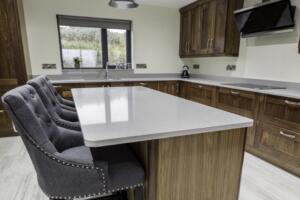
Why this matters in 2026
Three things converged:
- Australia introduced its engineered stone ban in July 2024 — becoming the first country in the world to introduce a national prohibition of this type. For the purposes of the prohibition, Safe Work Australia defines engineered stone as an artificial product containing at least 1% crystalline silica by weight alongside other specified criteria.
- UK HSE has increased its focus on respirable crystalline silica and the controls required when stone worktops are cut, shaped and installed.
- Major manufacturers launched lower-silica and zero-silica ranges in 2024–2025, including Caesarstone Mineral, Cosentino Silestone XM, Compac Unique and newer 0% crystalline silica mineral surfaces.
The UK has not banned engineered stone. There is no imminent nationwide ban scheduled.
However, awareness of crystalline silica exposure during fabrication is increasing, while manufacturers continue to introduce surfaces with lower crystalline silica content.
Zero silica vs low silica: what the labels mean
Not every worktop marketed as a alternative contains zero silica. Among the engineered mineral surface ranges sold in the UK, the crystalline silica content falls into three broad tiers:
| Tier | Crystalline silica content | UK ranges |
|---|---|---|
| Zero silica | 0% | Elorā |
| Effectively zero | Under 0.1% | Caesarstone Mineral |
| Low silica | 1–10% | Compac Unique (<4%), Silestone XM (<10%) |
All four contain substantially less crystalline silica than many traditional engineered quartz formulations. If the exact figure matters — for example for a fabricator’s risk assessment — check the manufacturer’s current technical specification rather than relying on the range name. Solid surface and porcelain worktops sit in different material categories and are outside the engineered mineral surface comparison in this guide.
Independent test evidenceSGS composition analysis of a zero-silica reconstituted stone sample reported 0 wt% quartz (crystalline silica). SGS also reported that the characteristic peak of quartz (crystalline silica) was not found.
The composition analysis used FTIR, PGC-MS, EDX, TGA and XRD.
SGS Test Report XMIN2504000844CM01_EN. Report dated 27 October 2025. Results relate only to the sample tested. Quantitative data is stated by SGS as being for reference only.
Are low silica quartz worktops available in the UK?
Yes. Low silica quartz worktops are available in the UK today. They are engineered surfaces designed to retain the familiar appearance and practicality of quartz while containing substantially less crystalline silica than traditional engineered quartz.
Traditional engineered quartz has historically contained more than 90% crystalline silica in many formulations. By comparison, newer low silica worktops can reduce this significantly. The ranges already covered in this guide include Compac Unique at under 4% crystalline silica and Silestone XM at under 10%.
Low silica quartz worktops are different from true zero silica surfaces. A low silica product still contains some crystalline silica, while a surface with 0% crystalline silica uses a different mineral formulation.
The section above explains the difference between zero silica, effectively zero and low silica in more detail.
For buyers who want the familiar quartz look and price position, these lower-silica surfaces can provide a useful middle ground. They retain many of the visual and practical qualities associated with engineered quartz while substantially reducing the crystalline silica content of the material.
We can show and compare lower-silica and zero-silica options at our Watford, Northampton and High Wycombe showrooms. Specifications vary between manufacturers and individual ranges, so check the current technical information for the exact surface you are considering.
See the full brand comparison below for the available options, specifications and buying information.
Who should choose zero silica?
You don’t need a zero silica worktop. Properly fabricated and installed in your kitchen, traditional quartz is safe to live with — the main crystalline silica dust risk occurs during cutting and fabrication rather than normal use of the installed surface.
That said, zero silica worktops make sense if:
- You care about the people who fabricate your stone. Reducing the crystalline silica content of the material can reduce one source of silica exposure during fabrication alongside appropriate dust controls.
- You’re planning a long hold. Lower-silica formulations are becoming increasingly important within the engineered surface industry.
- You want a clearly stated silica figure. Some buyers prefer being able to compare the actual crystalline silica percentage rather than relying on general product terminology.
- You’re comparing newer material technologies. Manufacturers continue to develop mineral surfaces with substantially lower crystalline silica content.
- You like the design. Many zero and lower-silica ranges now include strong marble-effect, warm-veined and contemporary finishes.
You don’t need to choose zero silica if you’re already happy with another properly specified surface, if the price difference puts you over budget, or if the colour you want is available only in another material.
Zero silica brands available in the UK (2026)
Caesarstone Mineral
Caesarstone — one of the original engineered quartz manufacturers — launched the Mineral range in 2024 as a lower-silica alternative.
Composition: Recycled glass, feldspar and other non-silica minerals
Silica content: Less than 0.1%
Warranty: 25 years
Available colours: ~20 finishes including marble-look veined options
Heat resistance: Up to 150°C
UK availability: Yes, through certified fabricators including Stoned Collective
Typical UK price: £350–£650 per m² supplied and fitted
Caesarstone Mineral remains a near-zero-silica option for buyers comparing established engineered surface brands. Its crystalline silica content is under 0.1%, rather than 0%.
Cosentino Silestone XM
Cosentino’s XM range uses a hybrid formulation that substantially reduces crystalline silica compared with many traditional engineered quartz products.
Composition: Premium minerals, recycled materials, hybrid resin
Silica content: Less than 10%
Warranty: 25 years (via Cosentino’s standard warranty programme)
Available colours: ~30 finishes
Heat resistance: Up to 150°C
UK availability: Yes, widely available
Typical UK price: £380–£700 per m² supplied and fitted
Silestone XM is a low silica surface rather than a 0% crystalline silica product. If the exact percentage matters, compare the current specification for each range. In this guide, Elorā has a 0% crystalline silica composition, Caesarstone Mineral is under 0.1%, Compac Unique is under 4% and Silestone XM is under 10%.
Compac Unique
Compac — a Spanish engineered stone manufacturer — offers the Unique range as a lower-silica engineered surface option.
Composition: Marble dust, recycled glass, feldspar
Silica content: Less than 4%
Warranty: 15 years
Available colours: ~15 finishes, with strong marble-look options
Heat resistance: Up to 130°C
UK availability: Limited but growing
Typical UK price: £300–£550 per m² supplied and fitted
Compac Unique is often one of the more affordable established lower-silica options and may be worth considering where budget is a primary driver.
Elorā
Elorā by About Stone is a mineral surface range available in the UK with 0% crystalline silica by composition, currently the lowest crystalline silica figure among the engineered mineral surface ranges compared in this guide.
Composition: Non-silica mineral formulation; non-porous, no sealing required
Silica content: 0% crystalline silica
Warranty: Lifetime*
Available colours: 10+ marble-effect designs including Calacatta Oro, Taj Mahal, Palermo and Calacatta Viola
Heat resistance: As with all engineered stone, use a trivet for hot pans
UK availability: Yes — available through Stoned Collective showrooms
Typical UK price: £250–£300 per m² supplied and fitted
*Lifetime warranty is available on eligible installations through selected suppliers or fabricators, subject to applicable warranty terms.
As a newer range, Elorā’s colour library is smaller than Silestone’s or Caesarstone’s, and published technical data is more limited than the established brands provide. Ask to see full slabs before specifying — as with any veined design, small samples don’t show the full pattern flow.
For buyers specifically comparing lower-silica engineered surfaces, Elorā combines a 0% crystalline silica composition, marble-inspired designs and competitive price positioning. Depending on the supplier or fabricator used, eligible installations may also be offered with lifetime warranty cover, subject to the applicable warranty terms.
Other options to watch
- Lapitec — Italian full-body sintered stone in a different material category from resin-bound engineered quartz.
- Dekton by Cosentino — an ultra-compact surface with a different formulation and fabrication profile.
- Neolith — a sintered surface available in a wide range of finishes.
- Various newer zero and low silica brands entering the UK market. Quality, provenance and published specifications vary, so ask your fabricator for current technical documentation.
Zero silica vs traditional quartz: head-to-head
The table below compares traditional engineered quartz with Elorā and Caesarstone Mineral, two examples of the new generation of mineral surfaces with substantially lower crystalline silica content.
| Property | Traditional quartz | Elorā | Caesarstone Mineral |
|---|---|---|---|
| Crystalline silica | 90–93% | 0% | <0.1% |
| Surface type | Engineered quartz | Mineral engineered surface | Mineral engineered surface |
| Visual style | Wide range of quartz and marble-inspired finishes | Marble-inspired and natural-stone looks | Contemporary and marble-inspired finishes |
| Sealing | Not normally required | Not required | Not normally required |
| Hot cookware | Use a trivet | Use a trivet | Follow manufacturer care guidance |
| Warranty | 10–25 years depending on brand | Lifetime* | 25 years |
| Typical UK price | £250–£600/m² supplied and fitted | £250–£300/m² supplied and fitted | £350–£650/m² supplied and fitted |
| UK availability | Widely available | Available through Stoned Collective showrooms | Widely available |
*Lifetime warranty is available on eligible Elorā installations through selected suppliers or fabricators, including Mo’s Stonex, subject to applicable warranty terms.
The honest summary: modern mineral surfaces increasingly offer the look and practicality buyers associate with engineered quartz while substantially reducing crystalline silica content. For buyers specifically looking for a 0% crystalline silica worktop, Elorā is the 0% option included in this comparison.
How much do zero silica worktops cost in the UK?
Real 2026 pricing, supplied and fitted, for an average UK kitchen (about 5–6 m² of worktop):
| Brand & range | Per m² | Average kitchen total |
|---|---|---|
| Elorā | £250–£300 | £1,400–£1,700 |
| Caesarstone Mineral, entry | £350–£420 | £1,900–£2,400 |
| Caesarstone Mineral, premium veined | £550–£650 | £3,000–£3,700 |
| Silestone XM, entry | £380–£480 | £2,100–£2,700 |
| Silestone XM, premium | £580–£700 | £3,200–£4,000 |
| Compac Unique | £300–£550 | £1,700–£3,100 |
These prices include templating, fabrication, transport and installation across most of England. They exclude VAT, edge upgrades, sink cut-outs and any specialist fixings.
The premium over equivalent traditional quartz varies by range, colour and project. As more lower-silica materials enter the market, the price gap is likely to continue changing.
How to care for a zero silica worktop
Care is broadly similar to traditional engineered quartz. Wipe with a soft cloth and pH-neutral cleaner. Avoid bleach, oven cleaner, acetone and abrasive scourers. Don’t put hot pans straight from the hob onto engineered stone — use a trivet. Don’t cut directly on the surface — use a board.
Many zero silica mineral surfaces are non-porous and do not require sealing. Always follow the current care instructions for the exact product installed.
Common questions
Q: Is zero silica safer to live with?
A: The main documented health risk associated with crystalline silica from stone worktops occurs when dust is generated during cutting, grinding and fabrication. The concern is primarily occupational exposure during processing, rather than normal use of a properly installed kitchen worktop.
Q: Will the UK ban engineered stone like Australia did?
A: Not in the immediate term. The UK has not announced an Australian-style national ban. HSE continues to focus on controlling exposure to respirable crystalline silica during fabrication.
Q: Is zero silica more expensive?
A: It depends on the brand and design. Elorā is currently shown in this guide at around £250–£300 per m² supplied and fitted, while some established lower-silica brands cost more.
Q: Does zero silica look as good as quartz?
A: Yes. Modern zero and lower-silica ranges include strong marble-look, warm-veined, white, grey, beige and darker finishes. In many completed kitchens the visual difference from premium engineered quartz is difficult to identify without knowing the product.
Q: How long do zero silica worktops last?
A: Indefinitely under normal kitchen use. Warranty terms vary by brand and supplier. Caesarstone Mineral carries a 25-year warranty, while selected Elorā installations may be eligible for lifetime warranty cover subject to the applicable supplier or fabricator terms.
Q: Can I get zero silica worktops in the colour I want?
A: Probably. Between Caesarstone Mineral, Silestone XM, Compac Unique and Elorā, there is now a broad selection of marble-effect, white-veined, grey, beige and darker finishes. The Elorā range adds a further 10+ marble-effect designs.
Q: Do you offer zero silica worktops at Stoned Collective?
A: Yes. Zero and lower-silica surfaces are available to compare through our Watford, Northampton and High Wycombe showrooms. Elorā samples and displays are also available. Call ahead to confirm current colours and slabs on show.
Q: Is zero silica the same as Dekton or Neolith?
A: No. Dekton and Neolith are sintered or ultra-compact surfaces and sit in a different material category. Zero silica engineered mineral surfaces are intended to provide an alternative within the engineered-stone market.
Q: Which worktops contain 0% crystalline silica?
A: Among the engineered mineral surface ranges sold in the UK, Elorā has a 0% crystalline silica composition. Caesarstone Mineral is under 0.1%, Compac Unique is under 4% and Silestone XM is under 10%. Solid surface and porcelain worktops sit in different material categories.
Q: Is 0% silica different from “low silica”?
A: Yes. A surface with 0% crystalline silica has no crystalline silica specified in its formulation. Low silica generally refers to engineered surfaces that still contain some crystalline silica but at a substantially reduced percentage.
Q: What are low silica quartz worktops?
A: Low silica quartz worktops are engineered surfaces designed to retain the familiar appearance of quartz while containing substantially less crystalline silica than many traditional engineered quartz formulations.
Q: Which kitchen worktops have the lowest silica content?
A: Some newer engineered mineral surfaces have 0% crystalline silica in their composition, while lower-silica ranges contain small percentages. Laminate and timber also contain effectively no crystalline silica in the main worktop material. See our guide to silica in kitchen worktops for a wider material-by-material comparison.
Where to see zero silica worktops in the UK
The only way to make a final decision is to see slabs in natural light. Online sample swatches are unreliable for veined stones — the patterning depends on the specific slab.
- Watford worktop showroom — Hertfordshire / North London
- Northampton worktop showroom — Northamptonshire / Bedfordshire
- High Wycombe worktop showroom — Buckinghamshire / Thames Valley
Elorā samples and displays are also available through our showrooms. Call ahead to confirm current colours and slabs on display.
Visit a showroom (no appointment needed during opening hours) or send us your kitchen plan for a free quote within 24 hours.
Related reading
- Silica in Kitchen Worktops: Which Worktops Contain It?
- Kitchen Upstand Ideas 2026: Quartz, Granite & Dekton Options
- Quartz Worktops UK | Stylish & Low-Maintenance Surfaces
- Dekton Worktops UK | Ultra-Compact & Heat Resistant
- Quartz Worktops Prices at Trade Rates Across the UK
This guide was last updated in August 2026 by the Stoned Collective fabrication team. Prices, ranges and brand availability change frequently in this fast-moving category — contact us for the latest options.