
Are Quartz Worktops Better Than Glass?

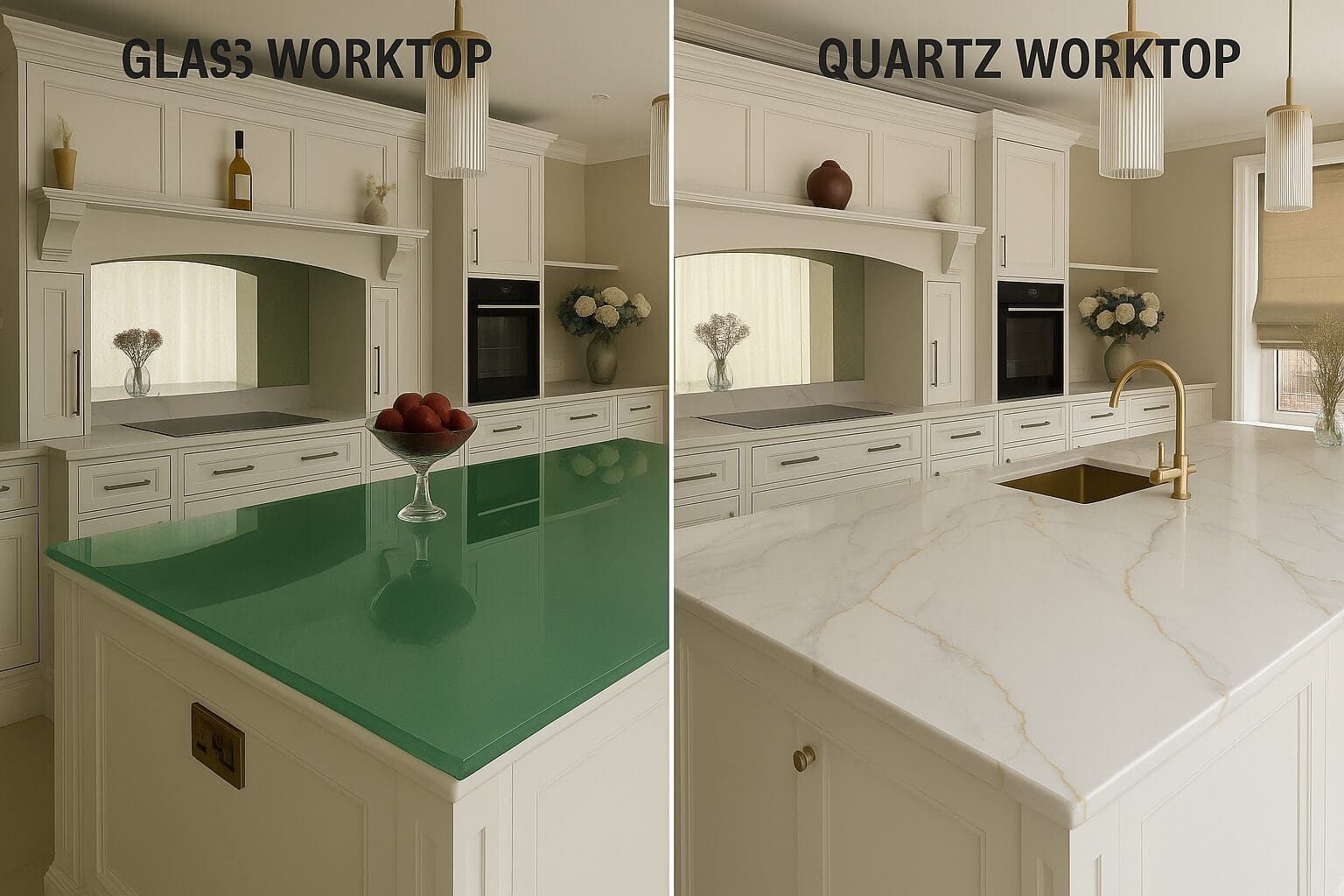
Quartz has been a trendiest and durable choice for kitchen worktops all over the UK (and even outside it all over the world). There are dozens of good reasons attached with quartz worktops that they are receiving love from the majority of the homeowners. On the other side, glass worktops are subtly shifting the meaning of luxury and style. These fine worktops are becoming part of our office rooms, drawing rooms, and any other place where they are necessary.
So, you will always see a battle between quartz worktops and glass worktops. No one clearly shares which one is a great option for your DIY kitchens and bathrooms. Both have their own pros and cons that make them worth your money. We are going to share all of those plus points and negative points of both materials of worktops. Let’s find the answer to this question: “Are quartz worktops better than glass?”
Are Quartz Worktops for Kitchens Better Than Glass?
Let’s see which one is best for your kitchen worktop: glass or quartz.
If we compare quartz countertops with glass worktops, quartz wins. It holds a supreme place for durability and low maintenance. Although both are known as one of the best non-porous and stain-resistant surfaces, quartz resists scratches, stains, and bumps more often than glass material. This means quartz is a better choice for the busiest kitchens. On the flip side, glass worktops offer aesthetic and eco-friendliness (quartz also does offer this). So, it’s obvious that the selection of quartz or glass countertops depends on your personality, taste, and needs.
In the next section, we are elaborating all of the essential factors and considerations before buying a worktop. It will enhance your power of decision making process and remove confusion about which material is great for your kitchen worktop.
Quartz vs Glass: Top 15 Features Compared
“Quartz is a better option than glass in many ways.” Let’s defend our statement with the help of valid reasons and factors. We are going to walk through the top 15 features that are compared between quartz and glass worktops, which will help you in picking the right choice for you and your kitchen.
Manufacturing Process
How are these two very different materials made? Their creation process gives them their unique properties. Let’s look at how Quartz and Glass worktops are produced.
Quartz
Quartz worktops are engineered stone. They are known as the “best man-made material for DIY kitchens and bathrooms in the entire history.” They are created in a factory environment. The process of manufacturing quartz slabs starts with grinding down natural quartz crystals.
Then, these crushed crystals of quartz are mixed with strong polymer resins. After this, colour pigments are added to get that specific look that its audience is always demanding and waiting for to install it in their homes. This mixture is then compacted under intense pressure and vibration. The resins bind everything together, forming a very hard and non-porous slab.
Glass
On the other hand, glass kitchen worktops are made from molten glass. This often includes a high percentage of recycled glass bottles or other waste glass. The glass is heated to very high temperatures until it melts. It is then poured into molds or rolled into sheets.
The glass cools and solidifies. For worktops, it is often tempered to increase strength and cut to size. Here, you can add pigments during the melting step for getting a desired colour. These types of materials for worktops are also commonly called “recycled glass worktops.”
Who Wins: Quartz or Glass?
The way they are made creates fundamental differences in the final product. This factor also decides how that worktop will behave in your kitchen. Quartz wins here. It is engineered stone versus molten and recycled glass. Let’s find out more below about why this manufacturing difference matters.
Aesthetics: Variety of Colours and Patterns
Do you have idea how will these worktops look in your new kitchen? This question clearly pays attention to an important fact that aappearance is a huge part of choosing between a worktop. In our case, both Quartz and Glass kitchen worktops offer different visual appeals. Let’s compare the design options you get in this section.
Quartz
Let’s first talk about quartz worktops. Homeowners know that these types of engineered stones provide amazing design flexibility. Because they are engineered, manufacturers like MO’s STONEX and Stoned Collective can create almost any colour imaginable.
Interestingly, you can find solid colours, subtle shades, and bold patterns. Quartz can even mimic the look of natural stone like Italian marble or granite with realistic veining. This means you can match your worktop to any kitchen style. Moreover, the control over pigments and materials allows for a vast and predictable range of looks.
Glass
Contrarily, glass worktops offer a sleek, stylish, and modern aesthetic. They come in a wide range of solid colours, achieved by adding pigment to the molten glass. Glass can also be back-painted for a solid, opaque look.
Some types have embedded materials for texture or sparkle. Plus, glass provides a clean and minimalist appearance. Although you get many colour options, it doesn’t typically replicate the complex veining or granular patterns found in stone.
Who Wins?
For the widest range of patterns, including natural stone looks, one material has the edge and that’s quartz. It offers more variety in mimicking natural patterns, especially Italian marble designs.
Heat Resistance
Can you place a hot pot, plate, or pan directly on the surface of quartz countertop and glass countertop? Or, are quartz better than glass in terms of heat-resistance? It is vital to find how well a worktop handles heat in any kitchen. Let’s compare Quartz and Glass on their ability to withstand high temperatures.
Quartz
Quartz worktops are designed to resist heat from normal cooking. The natural quartz crystals themselves can handle high temperatures. However, the resin binders used in engineered quartz are sensitive to extreme heat. Plus, how a quartz kitchen worktop handles heat depends on the quality of that quartz surface. At Stoned Collective, we provide high-quality quartz worktops that can endure higher temperatures very well.
Besides above-mentioned explanation, putting a very hot pot or pan straight from the hob or oven onto quartz can melt or discolour the resin. This causes permanent damage. Remember, quartz can typically endure temperatures up to around 150∘C (300∘F) without issue. Still, our experts recommend to always use a trivet or hot pad to protect your quartz surface from intense heat sources.

Read More: Can You Put Hot Pans on Quartz?
Glass
On the other hand, glass worktops are made at very high temperatures. So, they are naturally very heat resistant. Tempered glass, commonly used for worktops, can handle significant heat without melting or scorching. However, glass is susceptible to thermal shock.
This happens when there is a sudden, drastic change in temperature. It could be like placing a very cold item on a very hot surface. This can easily cause the recycled glass worktop to crack. For your information, glass recycled worktops can endure temperatures up to 200∘C (400∘F), but thermal shock is the main risk.
Who Wins?
For overall reliability against typical kitchen heat without risk of thermal shock, one material is slightly better. And our vote goes to quartz in heat resistance. It handles typical kitchen heat well. Glass is also heat-resistant but can crack from sudden temperature changes (thermal shock). While quartz resin is sensitive to extreme heat, glass has this specific vulnerability. So, always use trivets for very hot items on both.
Can You Put Hot Pans on Quartz? Is it Yes, or No? Follow the link to read more about it.
Stain Resistance
Spills and stains are just part of kitchen life. But, “how well do these surfaces handle drops of coffee, wine, or cooking oil” is the real question. Stain resistance is super important for keeping your worktops looking spotless. It is time to compare how worktop Quartz vs Glass stand up to spills.
Quartz
When we talk about quartz worktops, we talk about how excellent these surfaces are at resisting stains. They are made using resins that create a completely non-porous surface. In other words, liquids cannot soak into the material at all. And spills just sit on top, waiting to be wiped away.
This means things like red wine, juice, or food colouring will not leave permanent marks. The good news is that cleaning is easy with just soap and water. This non-porous quality makes quartz incredibly hygienic and stain-proof under normal use.

Glass
Glass worktops are also highly stain resistant just like quartz. Glass itself is a non-porous material. Liquids and food spills cannot penetrate the surface. This makes cleaning spills very straightforward.
A quick wipe with a cloth is enough to remove most stains. Like quartz, its non-porous nature makes it a very hygienic surface, preventing bacteria from soaking in. In this way, stains are not a common problem on a glass worktop surface.
Who Wins?
Both materials are fantastic at resisting stains because they are non-porous. It’s a tie.
Consistent Appearance
Do you want your countertop to look exactly the same as the sample? Or is some variation okay? Consistency in appearance is a key difference between these two materials. Let’s see how predictable their looks are.
Quartz
As you know, our experts at Stoned Collective are designing quartz slabs in perfect uniformity. The manufacturing process is tightly controlled. This ensures that the colour, pattern, and texture are incredibly consistent from one slab to the next.
If you need multiple pieces for a large kitchen, they will match seamlessly. What you see in a small sample piece is precisely what the full installed worktop will look like. This engineered consistency makes planning your design simple and removes any visual surprises.
Glass
Just like quartz, glass worktops also offer a very consistent appearance. Since the colour is added to the molten glass or back-painted, the hue is uniform across the entire panel. If you order multiple glass pieces in the same colour, they will look identical.
Thus, there are no natural variations like those found in natural stone. The look is clean, solid, and predictable from edge to edge. This makes it easy to achieve a sleek, uniform design.
Who Wins?
For getting a look that is exactly as expected, both materials offer great consistency. It’s a tie here. This level of predictability is important for your kitchen design.
Water Resistance
How do these quartz and glass surfaces handle splashes and spills? Kitchens are wet places, so your worktop must be good to go with water. Comparing how Quartz and Glass stand up to moisture will decide what is the best material.
Quartz
Quartz worktops are fantastic with water and moisture. That’s why they are widely used as splashbacks and upstands. They are engineered as completely non-porous surfaces. This means liquids cannot seep into the material at all.
As we have mentioned before in the spill-resistance section, water just sits on the surface until you wipe it away. This makes quartz ideal for areas around sinks and taps. Its structure prevents any water damage like swelling or warping. It stays looking great even with constant exposure to moisture.
Glass
Glass worktops are also excellent with water. This is because glass is a naturally non-porous material. Water and other liquids cannot be absorbed into the surface.
In addition to that, spills are easy to clean up with a simple wipe. This non-porous quality makes glass very hygienic. It prevents water damage and keeps the surface looking clean and new.
Who Wins?
Both materials are completely non-porous and handle water perfectly. It’s again a tie. This nature of quartz vs glass kitchen worktops makes them great for kitchens.
Cost of Quartz and Glass
Let’s talk about the glass and quartz price differences. After all, your budget is always a key player in kitchen decisions. How do the costs of Quartz and Glass worktops stack up against each other?
Quartz
Homeowners completely trust quartz worktops when it comes to budget-friendly options. These surfaces are considered a premium material, and their price reflects that. However, the quartz worktop cost is influenced by the the following factors:
- Engineering process
- Percentage (%) of natural quartz used
- Complexity of the colour or pattern
- How far it is transported?
While it is a significant investment upfront, quartz offers excellent durability and low maintenance. As a result, it can provide value over many years. So, quartz countertop prices are predictable within different tiers based on design.
Glass
Glass worktops can vary quite a bit in cost. Standard clear or coloured glass is comparable to mid-range quartz. However, thicker glass, custom shapes, special finishes like back-painting, or integrated features can make glass worktops very expensive.
Recycled glass countertop options can sometimes be more budget-friendly. But overall, glass is priced similarly to or even higher than quartz, especially for unique designs. So, which material is perfect if you prioritise cost factor?
Who Wins?
For a more predictable and slightly lower premium price point, one material takes the lead. Actually, that’s quartz here. Here, you need to find out if the cost of your selected quartz design fits your budget.
Maintenance
How much work will it take to keep your worktop looking clean and new? We are going to share facts on this consideration as maintenance is a big factor for busy households. Let’s compare the maintenance-level needed for both types of worktop surfaces.
Quartz
Quartz worktops are incredibly easy to maintain. The behind behind it very simple; their engineered surface is 100% non-porous. This means spills like coffee, wine, or oil just sit on top; they do not damage the slabs.
But, how to clean quartz?
Cleaning is simple. You just require warm water and mild soap. You never need to seal a quartz worktop. Its non-porous nature also makes it very hygienic. It resists bacteria growth like a pro. Also, it is a low-effort surface for daily cleaning.
Glass
It is easy to clean glass worktops, too. As we have mentioned before, glass is non-porous. So, liquids and food spills cannot penetrate the glassy surface. A quick wipe with a damp cloth and glass cleaner is usually enough to keep it clean.
However, glass surfaces, especially polished ones, tend to show fingerprints, smudges, and streaks very easily. This means you will find yourself wiping it down more frequently to keep it looking perfectly spotless.
Who Wins?
Both are easy for keeping your worktop clean with minimal fuss. But one shows less daily grime. Quartz wins here. It is the slightly lower-maintenance champion for your kitchen from Stoned Collective.
Durability
What happens if something heavy drops or a sharp object hits your worktop? Can the damage be fixed easily? How well do these materials respond to repairs? Let’s compare how fixable Quartz and Glass surfaces are. This section will find out how durable both materials are.
Quartz
So, how durable quartz worktops are? They are extremely durable than any other material. They are made mostly from natural quartz crystals, which are extremely hard.
The resins and manufacturing process create a dense, tough slab. This makes quartz highly resistant to scratches, chips, and cracks from everyday kitchen activities. It can handle impacts well and maintains its surface integrity over many years of use.
Glass
On the flip side, glass countertops are also quite durable, especially if they are made from tempered glass. Tempering makes the glass much stronger than regular glass. It resists scratches well from normal use.
However, glass is vulnerable to chipping or breaking from sharp, heavy impacts, especially on the edges. Although tough, it doesn’t have the same overall impact resistance as quartz.
Who Wins?
Quartz wins for providing overall toughness and durability against chips and impacts. It is engineered for higher resistance to daily wear and tear. This toughness clearly shows a difference.
Edge Profile Options
The shape you choose for the edge of your worktop impacts the kitchen’s style. It is a detail that adds polish. Let’s look at the different edge choices available for these two materials.
Quartz
This engineered surface offers fantastic flexibility for shaping edges. Because it is a solid material, fabricators can cut and polish the edges into many different designs. You can pick simple styles like a clean eased edge or a slight bevel.
More decorative options like a curved bullnose, elegant ogee, or even stacked edges are easily created. This wide selection lets you perfectly customise the look to match your kitchen’s specific design vision, whether modern, conventional, or traditional.
Glass
This sleek material usually has more limited edge options. Standard glass worktops often feature a simple polished straight edge or a slightly rounded pencil edge. While it’s possible to create other shapes, the process is more complex and costly than with stone or engineered stone. Complex profiles like ogee or bullnose are not typically available or practical with glass. The edge finish is usually clean and minimalist, matching the material’s modern aesthetic.
Who Wins?
For the most creative control over edge design, one material offers more possibilities. Quartz wins here! It provides a much wider variety of custom edge profiles. Find out which edge style fits your kitchen!
Eco-Friendly
How do these materials impact our environment? Many people are thinking about sustainability today. Let’s look at how green Quartz and Glass worktops are.
Quartz
Considering the environmental footprint of this engineered stone involves looking at its components. As you know the main ingredient is natural quartz, it is abundant. The process of mining and manufacturing uses significant energy.
However, many companies are improving by incorporating recycled materials like glass or mirrors into their quartz slabs. The long lifespan and durability of quartz also mean it doesn’t need replacing often, which reduces waste over time.
Glass
This smooth glass surface has a strong eco-friendly story. Many glass worktops are made using a high percentage of recycled glass, sometimes up to 100%. This diverts waste from landfills and reduces the need for virgin raw materials.
While melting glass requires energy, the use of recycled content significantly lowers the overall environmental impact. So, recycled material is used here as compared to making new glass. Not only that, glass is non-toxic and inert that makes it a worth buying choice.
Who Wins?
When focusing on recycled content and waste reduction, one material has a clear advantage. That’s glass. Its potential for high recycled content makes it a greener choice.
Value of Property
Does installing this work top help when you sell your home? How do potential buyers see these materials? Let’s look at how Quartz vs Glass impact your property’s value.
Quartz
Engineered quartz stone is always seen as a solid investment for resale. Buyers recognise quartz as a modern, high-quality upgrade. They appreciate its durability, low maintenance, and stylish appearance.
Besides that, installing quartz gives a message to the person (who sees it for the first time) that the kitchen is updated and well-maintained. This is how perceived value for the home is increased. It makes the property more attractive and can help it sell faster.
Glass
The glass material can also appeal to buyers, but it is more of a niche taste. Worktops made of glass offer a very contemporary and unique look. Buyers who love modern design will see it as a premium feature.
However, some buyers will be concerned about its perceived fragility or potential for fingerprints. So, it adds a sense of luxury and uniqueness to your home. Still, its impact on broad resale value is slightly less universal than quartz.
Who Wins?
For a more widely recognised boost to property value, one material has a slight edge. Quartz is the winner. It is seen as a universally desirable premium upgrade. That’s why buyers love it.
UV-Rays Resistance
Will your worktop fade or change colour if it is placed in direct sunlight? How well do these materials handle exposure to UV rays from the sun? This is important for DIY-kitchens with large windows or skylights.
Quartz
This engineered surface is sensitive to long-term exposure to direct sunlight. The resins used to bind the quartz crystals can sometimes yellow or discolour over time due to UV radiation.
This means areas of a quartz worktop that receive intense and unfiltered sun daily will start showing a visible change in appearance. In shaded areas, that’s not going to happen. So, it is advised to avoid using quartz in outdoor settings or areas with significant direct UV exposure.
Glass
This is a sleek material that is naturally resistant to UV rays. Glass itself does not degrade or change colour from exposure to sunlight. The pigments used to colour the glass are also stable under UV light.
Moreover, you don’t have to worry about a glass worktop fading or yellowing over time, even in sunny locations. This is why it is a reliable choice for kitchens with lots of natural light or even for certain outdoor applications.
Who Wins?
For keeping its true colour under direct sunlight, one material is inherently better. That’s glass. It is much more resistant to UV rays than quartz. But most of the quartz surfaces are available for outdoor use at Stoned Collective.
Repairability
Kitchen-oriented things can get dropped or bumped on your newly installed counter top. What happens if your beautiful worktop gets damaged? Can it be fixed to look new again? Let’s compare how easy it is to repair Quartz and Glass surfaces.
Quartz
This engineered stone is tough, but fixing damage is not always simple. If a small chip occurs, sometimes it can be filled with a special colour-matching resin. However, it is often very difficult to make the repair completely invisible, especially on surfaces with patterns or speckles.
Deep scratches or larger chips are even harder to fix seamlessly. If the damage is significant, the best solution is to replace the damaged section or even the whole slab. It is a costly process requiring professional help.
Glass
Damage to this material, like chips or cracks, is also challenging to repair. Although it is understandable that tempered glass is strong, sharp impacts can still cause chips. More specifically, it happens on the vulnerable edges.
Unlike some materials, glass cannot be easily sanded or polished to remove scratches or minor surface imperfections. If a glass worktop suffers significant damage, such as a large crack or chip, it requires complete replacement. Repairs are not visually appealing or structurally sound.
Who Wins?
Fixing damage on either material is difficult; major issues usually mean replacement. It is a tie here. This shows preventing damage is the rule of happiness for both materials.
Suitability with DIY Kitchen Projects
Are you planning to install your new worktops yourself? This is an important question. Working with heavy, hard materials like these requires specific skills and tools. Let’s see how suitable Quartz or Glass are for a DIY approach.
Quartz
Installing this engineered stone is challenging for most DIYers but not impossible. Actually, the slabs are extremely heavy that make them difficult and dangerous to lift and move without professional help and equipment. So, cutting and shaping quartz requires specialised diamond blades and powerful tools.
It is a hard, dense material, and mistakes can easily lead to costly chips or cracks. Professional fabrication and installation are strongly recommended to ensure a perfect fit and avoid damaging the material or causing injury.
Glass
Working with this sleek material also presents significant challenges for DIY installation. Glass slabs, especially thick ones, are heavy. Although the surface is hard, the edges are vulnerable to chipping or breaking if not handled with extreme care.
Cutting glass accurately for sinks or hobs requires specialised equipment and expertise to prevent cracks or shattering. Like quartz, it is best to have glass worktops professionally measured, fabricated, and installed for safety and a flawless finish.
Who Wins?
Both materials are not 100% suitable for DIY installation due to weight, required tools, and risk of damage. But quartz is the winner as you can do it easily with knowledge, experience, and right equipment. Still, professional installation is recommended for both. Expert fitting is best.
Read more here: Can you fit DIY kitchens yourself?
Final Score – Who’s the Winner: Quartz or Glass?
Final Score – Who’s the Winner: Quartz or Glass?We’ve looked closely at 15 features comparing Quartz and Glass worktops. The results show a clear leader based on our factors. Quartz won on 7 points, including durability, heat resistance, and lower maintenance. Glass won on 2 points, like UV resistance and eco-friendliness.
They tied on 6 factors, such as stain and water resistance. Based on this head-to-head, Quartz is the overall winner for kitchens. The final score is Quartz 10/15 and Glass 5/15. So, let’s conclude with a statement that quartz offers more practical benefits for busy kitchens.
You can get your quartz worktops from one of the leading providers all over the UK, “Stoned Collective.” Call us at 01923223859 or 07432065334.
Here is another worth reading review, “”Is Quartz Worktop Better than Granite?”